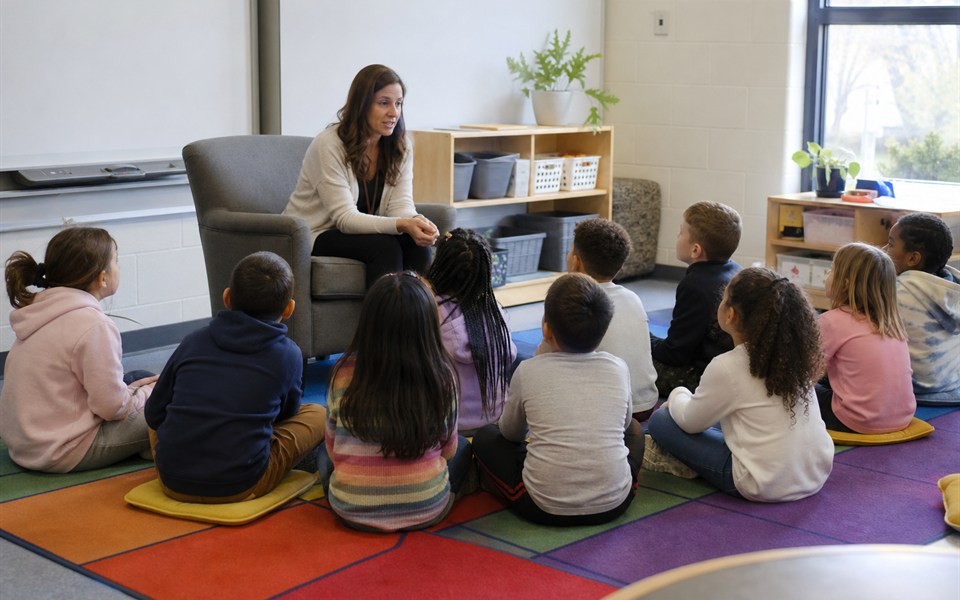

Morning meeting is a short, reliable opening that builds belonging and readiness. Done well, it takes 10–20 minutes and pays for itself in smoother transitions and warmer peer culture. Students practice speaking, listening, and community norms in a structure that feels safe because it repeats.
You do not need a perfect circle or elaborate props. You need a predictable sequence, a clear attention signal, and prompts that fit your students’ ages. Secondary advisory can use the same bones with more mature prompts.
A simple four-part structure
- Greeting
- Sharing
- Activity or warm-up
- Morning message / daily preview
Keep the order the same so students feel safe. Rotate the content inside each part. If time is tight, run greeting + message only and protect the habit.
Greeting ideas that do not take forever
- Handshake or wave with eye contact
- Greeting train around the circle
- Ball toss greeting with names
- Multilingual hello of the week
- Silent greeting challenge (wave patterns)
Teach the greeting as a routine with a start and stop signal. Practice once, then expect fluency.
Sharing without losing the clock
Use a prompt and a sentence frame. Limit to a few volunteers or use partner share, then one spotlight. Topics can be weekend highlights, something kind they noticed, a learning goal for the day, or a strategy they will try in reading or math.
Set boundaries: school-appropriate shares, no interrupting, and a way to pass. If a student shares something concerning, follow your school protocols and offer a private check-in later.
Quick academic warm-ups
Tie the activity to your content: number talks, vocabulary charades, “would you rather” science questions, geography riddles, or a one-sentence main idea challenge linked to main idea practice. Academic warm-ups make morning meeting easier to justify on packed schedules.
Morning message ideas
- Agenda preview with one exciting highlight
- A class question students answer on sticky notes
- A grammar or editing challenge embedded in the message
- A celebration of a classroom routine done well yesterday
When time is short
Run a “mini meeting”: greeting + message only. Consistency beats length. On assembly days, even three minutes of greeting preserves the ritual.
Launching mid-year
Explain why you are adding morning meeting, teach the structure explicitly, and keep the first week especially predictable. Invite student feedback after two weeks: What helps? What feels too long?
Prompt banks you can rotate all year
Community prompts: “Who helped you yesterday?” “What is one kindness you can offer today?” Academic prompts: “What strategy will you try in reading?” “Share a number that surprised you.” Reflection prompts: “What was hard and how did you handle it?” Seasonal prompts can appear, but the everyday bank matters more.
Store prompts on rings or slides so you are not inventing at 7:55 a.m. Student-generated prompts are powerful once norms are strong—teach how to propose a prompt that is inclusive and school-appropriate.
Assessing the impact without killing the joy
You do not grade morning meeting, but you can notice patterns: Are more students volunteering? Are transitions after meeting faster? Are peer conflicts decreasing? Jot monthly notes. If meeting runs long and steals instructional time, tighten sharing rather than abandoning the ritual.
Share the purpose with families in a newsletter blurb so morning meeting is understood as social and academic warm-up, not “just talking.” That clarity protects the practice when schedules get tight.
Sample two-week rotation
Week A focuses on community: longer greeting variety, partner shares, and a cooperative challenge. Week B leans academic: number talk or vocabulary warm-up after a quick greeting, then a concise message. Alternating emphasis keeps the meeting fresh without rewriting your entire opening every day.
On Mondays, include a weekend share with tight time limits. On Fridays, include a week reflection: “What is one win from this week?” These anchors help students feel the rhythm of school time and give you informal formative information about morale and belonging.
If behavior is rocky after meeting, examine the transition out of the circle more than the meeting itself. Practice standing, pushing chairs, and moving to the next learning space as its own mini-routine.
Materials that make meeting smoother
Keep a dedicated morning meeting basket: greeting cards, a soft toss object, prompt rings, and a class mascot if you use one. When materials live together, setup takes seconds and you are less tempted to skip the ritual on busy days.
FAQ
Does morning meeting work in secondary?
Yes, as a brief community opener or advisory routine with age-appropriate prompts.
What if students share sensitive information?
Teach boundaries: school-appropriate shares, and offer private check-ins afterward when needed.
How do I start mid-year?
Explain why you are adding it, teach the structure explicitly, and keep the first week especially predictable.
What if my room cannot sit in a circle?
Use rows with a turn-and-talk greeting, or stand in a U-shape. The relationship work matters more than the furniture arrangement.