
Clear family communication builds trust and prevents small issues from becoming big ones. Templates are not impersonal—they are starting points you personalize so you are not rewriting the same email at 9 p.m. The best messages are specific, calm, and actionable.
Follow your district’s approved channels and documentation expectations. Templates support professionalism; they do not replace judgment when a situation is sensitive or safety-related.
Principles that keep messages effective
- Lead with care and a specific observation
- Separate facts from interpretations
- Offer one clear next step
- Invite partnership, not blame
- Keep paragraphs short
- Proofread names and pronouns carefully
Positive note template
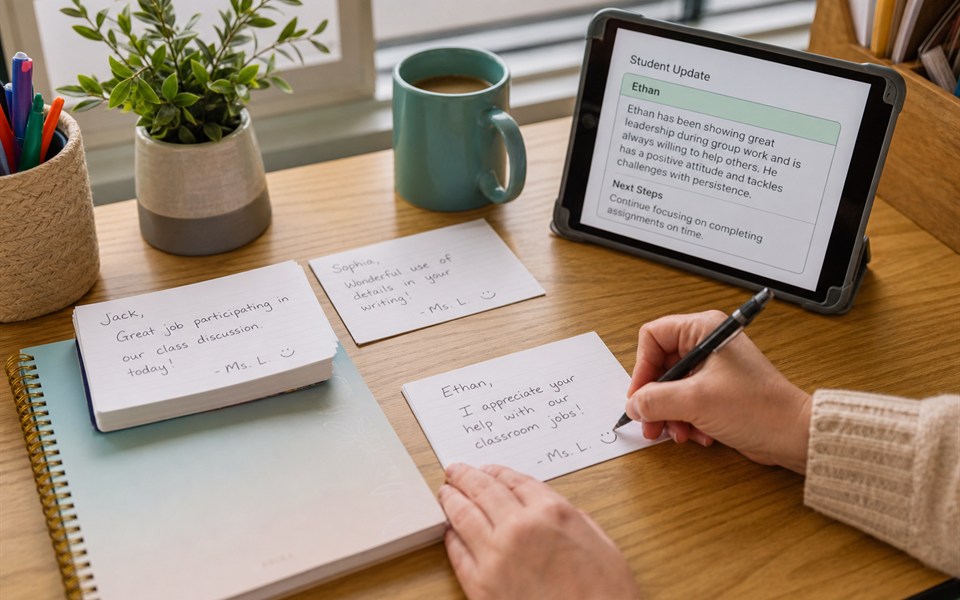
“I wanted to share something I noticed today: [specific behavior or growth]. It mattered because [impact on learning/community]. Thank you for the support you provide at home.”
Send positives early—especially for students who often generate problem-focused contact. A bank of genuine positives changes the tone of later conversations.
Conference reminder template
Include date, time, location/link, what to bring, and how to reschedule. Add one sentence about the purpose of the meeting. If interpreters are needed, note how that is arranged per school process.
Concern template (early and calm)
State the pattern, share what you have tried, ask what works at home, and propose a check-in date. Avoid stacking multiple issues into one first message. One pattern, one request, one follow-up time.
Sample concern outline
- Appreciation or context
- Observable pattern with timeframe
- Supports already tried in class
- Question for the family
- Proposed next step and date
Weekly or biweekly update structure
- Learning highlight
- Upcoming dates
- How families can support in 10 minutes or less
- Appreciation or class shout-out
Channels and boundaries
Follow district policy for apps, email, and phone calls. Set expectations for response windows so urgent safety issues go through official channels. You can be warm and still protected by clear boundaries.
Documentation habits
Save sent messages according to school guidance. Note phone call outcomes briefly. Patterns matter for student support teams and for your own memory during busy seasons.
More fill-in templates
Missing work: “I’m checking in about [assignment] due on [date]. [Student] can complete it by [new date] for credit according to our policy. How can we support follow-through at school and at home?”
Behavior follow-up: “Today we practiced [expectation] after [brief factual description]. Next step at school is [support]. I’d value any insight about what helps [student] reset.”
Celebration of growth: “Over the past [timeframe], I’ve noticed growth in [skill/behavior]. Evidence looked like [example]. Please celebrate this with [student]!”
When to pick up the phone instead
Use a call or conference for emotionally charged topics, repeated unresolved concerns, or anything that could be misread in text. Start with care, share facts, listen longer than you speak, and end with an agreed next step. Afterward, send a brief summary email so everyone remembers the plan.
If communication becomes hostile or unsafe, follow school protocols immediately and do not continue the thread alone.
Newsletter section formulas
Keep family newsletters scannable: three bullets max for learning highlights, a dated list of upcoming events, and one optional home connection. Link longer resources rather than pasting essays. If you attach printables, make sure they are optional enrichment, not surprise homework.
Use the same subject-line pattern so families recognize your messages: “Room 12 update — week of May 12.” Consistency builds open rates. Avoid sending multiple tiny emails when one digest will do, unless the issue is time-sensitive.
Close most messages with how to reach you and your typical response window. Clarity reduces repeated “Did you get my email?” threads and models the professional boundaries you need for sustainable teaching.
Conference conversation map
Open with a strength, share two pieces of evidence, ask what the family notices at home, agree on one school goal and one home support, then summarize next check-in. Bring student work samples rather than only grade averages. End by thanking families for partnership�even when the conversation was hard�so the relationship stays intact for the next message.
After conferences, send a short follow-up using your concern or celebration template so agreements are written down. That single habit prevents months of �I thought we said�� confusion and keeps support teams aligned when multiple adults help a student.
FAQ
What if a parent replies angrily?
Pause, acknowledge feelings, restate facts, and offer a phone or in-person conversation. Loop in support staff when needed.
How often should I send positives?
Aim for early positives before concerns, especially for students who often generate problem-focused contact.
Can templates work for multilingual families?
Use district translation supports, plain language, and visuals or bullet points that travel well across translations.
Should I reply instantly after hours?
Model sustainable boundaries unless policy or safety requires otherwise. A next-school-day response is often appropriate.