

If lesson planning regularly spills into Sunday night, you do not need more willpower—you need a timed system. This 60-minute method prioritizes the lessons that matter most, reuses structures you already trust, and leaves enrichment for leftover minutes instead of the other way around. Teachers who adopt a fixed planning window often report that the quality of their plans improves because decisions stop competing with endless browsing.
The goal is not a perfect binder. The goal is a week you can teach from Monday morning without reconstructing everything in your head during prep. When your planning session has a clear sequence, your brain stops reopening every curriculum tab “just in case.”
What you need before the timer starts
Gather your standards or pacing guide, last week’s plans, assessment calendar, and a one-page weekly template. Open only the tabs you will actually use. Silence notifications. The goal is decision-making, not browsing. If you teach multiple preps, choose one “heavy” prep to plan deeply and lighter courses to clone from existing structures.
- Weekly overview template (paper or digital)
- List of fixed events: assemblies, testing, early release
- Notes on unfinished lessons from last week
- Materials that already exist for the upcoming skills
- A short list of students who need scaffolds this week
Keep a “parking lot” sticky note beside you. Any idea that is interesting but not essential for next week goes there. That single habit protects the timer.
Minutes 0–10: Map the skeleton
Write the weekdays across the top and your teaching blocks down the side. Block out non-negotiables first. Then jot one learning target per major block—just the skill, not the full lesson yet. If a day is half gone to a field trip or testing, plan a flexible review block instead of forcing a brand-new concept into a truncated window.
Glance at your assessment calendar. If a quiz lands on Thursday, Monday–Wednesday should build toward that check rather than introducing unrelated novelty. Planning backwards from known assessments is one of the fastest ways to cut fluff.
Minutes 10–35: Plan the must-teach lessons
For each target, sketch a four-part flow: warm-up, teach, practice, check. Borrow structures from previous weeks so you are not inventing a new format daily. Students benefit from predictable lesson rhythm; you benefit from faster planning.
A reusable lesson skeleton
- Activate prior knowledge in under five minutes.
- Model the new skill with one strong example.
- Release to guided or independent practice.
- Collect a tiny formative check.
If a subject appears every day, plan Monday deeply and clone the structure Tuesday–Thursday with new examples. Friday can be review, centers, or assessment. For literacy blocks, you might keep the same mini-lesson frame while changing the text. For math, keep the same workshop structure while changing the problem set.
Write materials in the order you will use them. “Copies on the counter, then notebooks, then manipulatives” is more useful during a rushed transition than a vague list at the bottom of a page.
Minutes 35–50: Materials and differentiation
List copies, books, manipulatives, and links beside each lesson. Add one scaffold and one stretch—not five. Differentiation should ride on the same objective so you are not planning three separate lessons disguised as one.
- Scaffold: sentence frames, fewer items, partner support, annotated model
- Stretch: challenge question, teach-a-friend task, extension menu, deeper text
If you run small groups, pencil in which group you will meet on which day. Even a light notation (“Group B: fluency”) prevents the week from becoming accidental whole-group only. Pair this with ideas from small-group reading centers when literacy rotations are part of your week.
Minutes 50–60: Buffer, sub notes, and brain dump
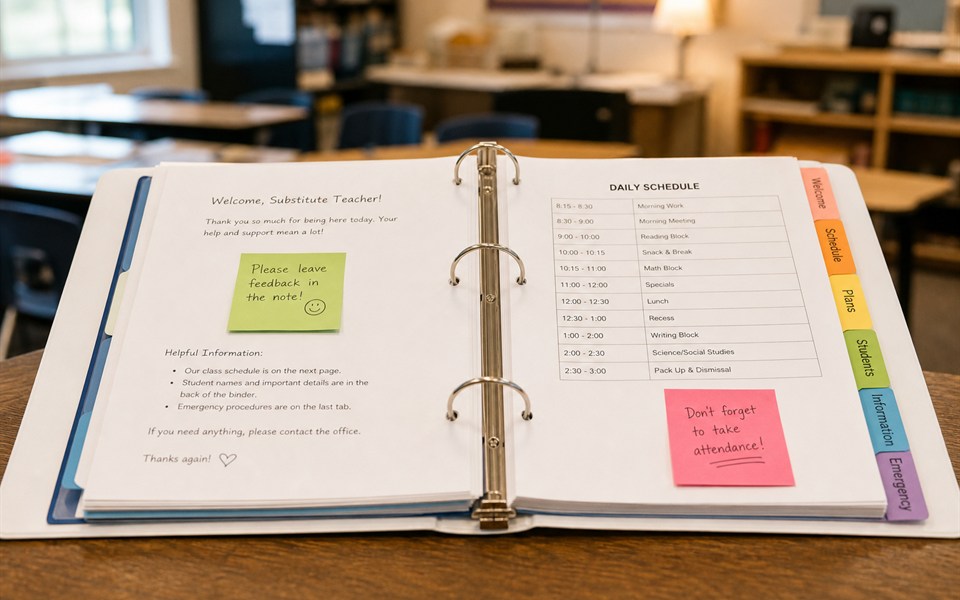
Write “if short / if long” notes for each major block. Drop emergency plans into your substitute binder thinking—even if you are not absent, the clarity helps. Capture anything still fuzzy in the parking lot so it does not reopen the whole plan.
End by scanning Friday. If Friday is overloaded, move a lighter review earlier and protect one flexible block for catch-up. Weeks fall apart most often because Monday–Thursday were ambitious and Friday had nowhere for overflow.
Common mistakes that blow the time box
- Searching for brand-new activities mid-plan
- Writing novel-length plans nobody will reread
- Planning enrichment before core instruction
- Ignoring fixed schedule interruptions
- Rebuilding formatting instead of reusing a template
- Trying to differentiate every single task equally deeply
A sample 60-minute agenda you can print
- 0–5: Open last week’s plan and note carryovers
- 5–10: Block calendar interruptions
- 10–20: Write learning targets for each major block
- 20–40: Flesh out must-teach lessons with the four-part skeleton
- 40–50: Materials, copies, and scaffolds
- 50–55: Formative checks and grading implications
- 55–60: Buffer notes and parking lot
If grading worries creep in during planning, park them and use a dedicated workflow later—see grading workflow time-savers.
Make next week even faster
Save your best warm-ups and exit tickets in a labeled folder. Keep a rotating set of center tasks. Build a personal “greatest hits” bank of mini-lessons that already work with your students. Pair this system with ideas from lesson planning.
After three or four weeks of timed planning, review what still takes too long. Often it is materials hunting. Solving that with labeled bins and a printables folder will shrink future sessions more than writing longer plans ever will.
FAQ
What if I teach multiple preps?
Plan the heaviest prep first in the 60 minutes, then clone structures for lighter courses. Alternating deep-plan days by prep also works if one hour cannot cover everything.
Should I plan digitally or on paper?
Use whichever you will actually open during the day. Many teachers draft on paper for speed and store masters digitally for reuse.
How do I handle last-minute schedule changes?
Protect a flexible Friday block and keep two low-prep review activities ready in your sub or emergency folder.
What if 60 minutes is not enough yet?
Start with 75 minutes for two weeks while your templates mature, then tighten. The sequence matters more than the exact number.
Related reading

Classroom Management
Classroom routines that run smoothly

Organization
Grading workflow time-savers
Organization